From Transformers to Associative Memory, How Titans and MIRAS Rethink Long Context Modeling

From Transformers to Associative Memory, How Titans and MIRAS Rethink Long Context Modeling


What comes after Transformers? Google Research is proposing a new way to give sequence models usable long term memory with Titans and MIRAS, while keeping training parallel and inference close to linear.

Titans is a concrete architecture that adds a deep neural memory to a Transformer style backbone. MIRAS is a general framework that views most modern sequence models as instances of online optimization over an associative memory.

Why Titans and MIRAS?

Standard Transformers use attention over a key value cache. This gives strong in context learning, but cost grows quadratically with context length, so practical context is limited even with FlashAttention and other kernel tricks.

Efficient linear recurrent neural networks and state space models such as Mamba-2 compress the history into a fixed size state, so cost is linear in sequence length. However, this compression loses information in very long sequences, which hurts tasks such as genomic modeling and extreme long context retrieval.

Titans and MIRAS combine these ideas. Attention acts as a precise short term memory on the current window. A separate neural module provides long term memory, learns at test time, and is trained so that its dynamics are parallelizable on accelerators.

https://research.google/blog/titans-miras-helping-ai-have-long-term-memory/

Titans, a neural long term memory that learns at test time

The introduces a neural long term memory module that is itself a deep multi layer perceptron rather than a vector or matrix state. Attention is interpreted as short term memory, since it only sees a limited window, while the neural memory acts as persistent long term memory.

For each token, Titans defines an associative memory loss

ℓ(Mₜ₋₁; kₜ, vₜ) = ‖Mₜ₋₁(kₜ) − vₜ‖²

where Mₜ₋₁ is the current memory, kₜ is the key and vₜ is the value. The gradient of this loss with respect to the memory parameters is the “surprise metric”. Large gradients correspond to surprising tokens that should be stored, small gradients correspond to expected tokens that can be mostly ignored.

The memory parameters are updated at test time by gradient descent with momentum and weight decay, which together act as a retention gate and forgetting mechanism.To keep this online optimization efficient, the research paper shows how to compute these updates with batched matrix multiplications over sequence chunks, which preserves parallel training across long sequences.

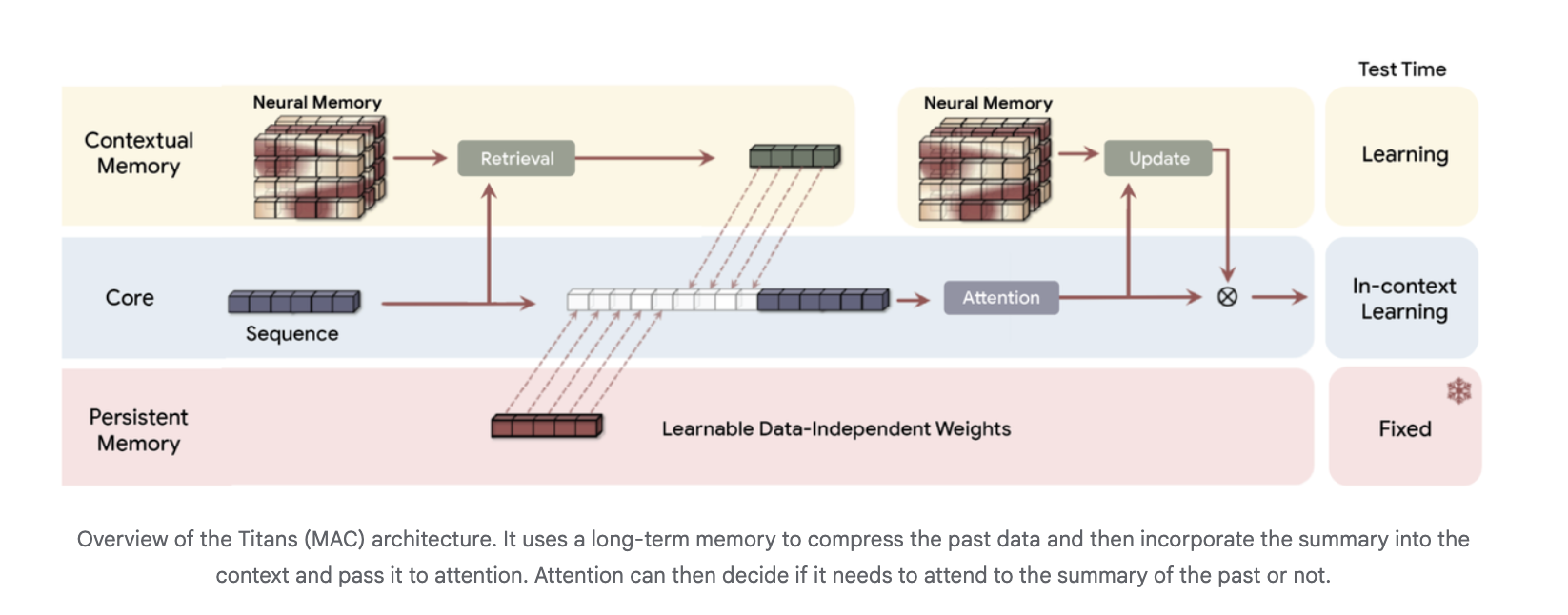
Architecturally, Titans uses three memory branches in the backbone, often instanced in the Titans MAC variant:

  • a core branch that performs standard in context learning with attention
  • a contextual memory branch that learns from the recent sequence
  • a persistent memory branch with fixed weights that encodes pretraining knowledge

The long term memory compresses past tokens into a summary, which is then passed as extra context into attention. Attention can choose when to read that summary.

Experimental results for Titans

On language modeling and commonsense reasoning benchmarks such as C4, WikiText and HellaSwag, Titans architectures outperform state of the art linear recurrent baselines Mamba-2 and Gated DeltaNet and Transformer++ models of comparable size. The Google research attribute this to the higher expressive power of deep memory and its ability to maintain performance as context length grows. Deep neural memories with the same parameter budget but higher depth give consistently lower perplexity.

For extreme long context recall, the research team uses the BABILong benchmark, where facts are distributed across very long documents. Titans outperforms all baselines, including very large models such as GPT-4, while using many fewer parameters, and scales to context windows beyond 2,000,000 tokens.

The research team reports that Titans keeps efficient parallel training and fast linear inference. Neural memory alone is slightly slower than the fastest linear recurrent models, but hybrid Titans layers with Sliding Window Attention remain competitive on throughput while improving accuracy.
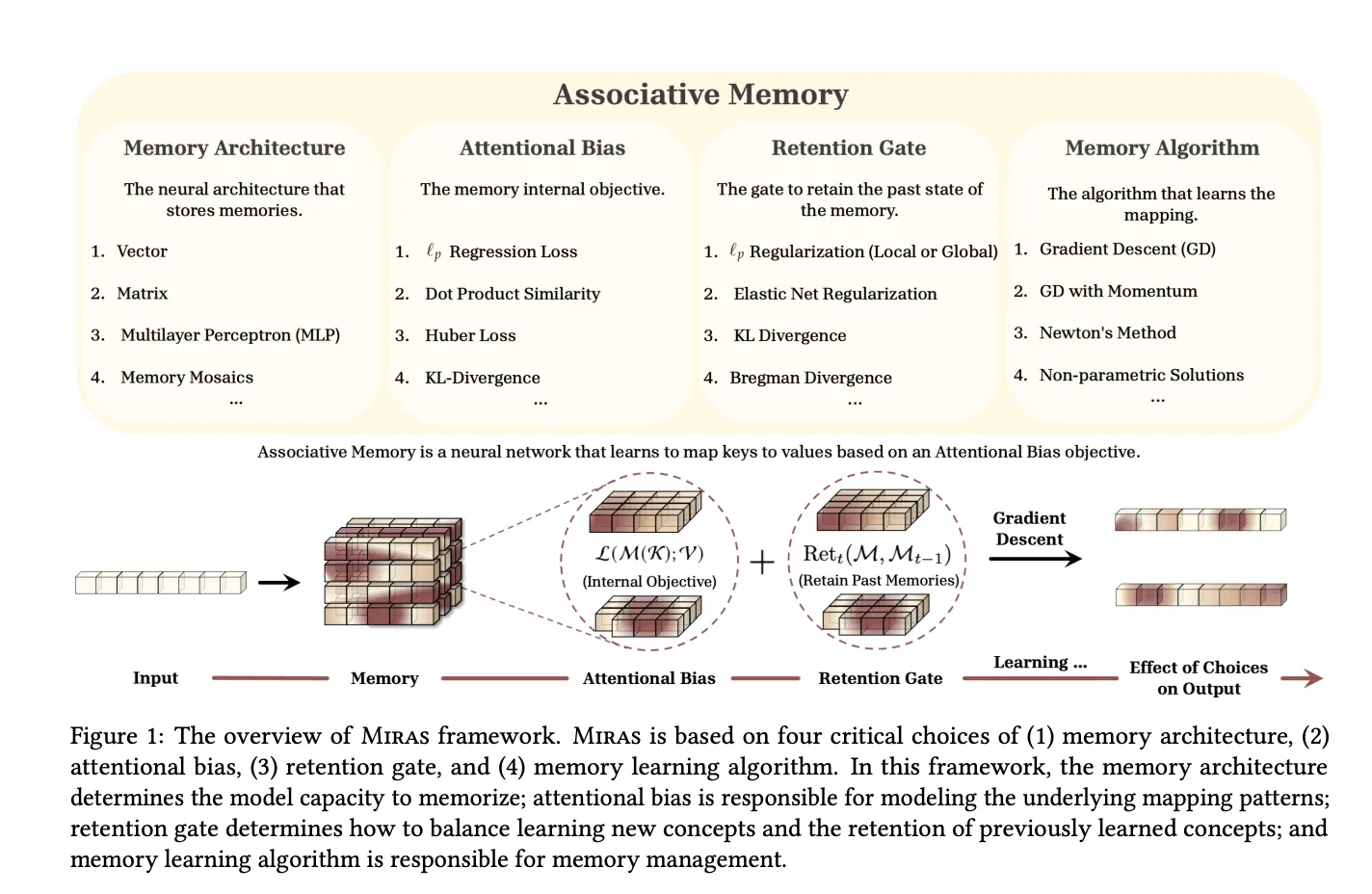
https://arxiv.org/pdf/2504.13173

MIRAS, a unified framework for sequence models as associative memory

The MIRAS research paper, ,” generalizes this view. It observes that modern sequence models can be seen as associative memories that map keys to values while balancing learning and forgetting.

MIRAS defines any sequence model through four design choices:

  1. Memory structure for example a vector, linear map, or MLP
  2. Attentional bias the internal loss that defines what similarities the memory cares about
  3. Retention gate the regularizer that keeps the memory close to its past state
  4. Memory algorithm the online optimization rule, often gradient descent with momentum

Using this lens, MIRAS recovers several families:

  • Hebbian style linear recurrent models and RetNet as dot product based associative memories
  • Delta rule models such as DeltaNet and Gated DeltaNet as MSE based memories with value replacement and specific retention gates
  • Titans LMM as a nonlinear MSE based memory with local and global retention optimized by gradient descent with momentum

Crucially, MIRAS then moves beyond the usual MSE or dot product objectives. The research team constructs new attentional biases based on Lₚ norms, robust Huber loss and robust optimization, and new retention gates based on divergences over probability simplices, elastic net regularization and Bregman divergence.

From this design space, the research team instantiate three attention free models:

  • Moneta uses a 2 layer MLP memory with Lₚ attentional bias and a hybrid retention gate based on generalized norms
  • Yaad uses the same MLP memory with Huber loss attentional bias and a forget gate related to Titans
  • Memora uses regression loss as attentional bias and a KL divergence based retention gate over a probability simplex style memory.

These MIRAS variants replace attention blocks in a Llama style backbone, use depthwise separable convolutions in the Miras layer, and can be combined with Sliding Window Attention in hybrid models. Training remains parallel by chunking sequences and computing gradients with respect to the memory state from the previous chunk.

In research experiments, Moneta, Yaad and Memora match or surpass strong linear recurrent models and Transformer++ on language modeling, commonsense reasoning and recall intensive tasks, while maintaining linear time inference.

Key Takeaways

  1. Titans introduces a deep neural long term memory that learns at test time, using gradient descent on an L2 associative memory loss so the model selectively stores only surprising tokens while keeping updates parallelizable on accelerators.
  2. Titans combines attention with neural memory for long context, using branches like core, contextual memory and persistent memory so attention handles short range precision and the neural module maintains information over sequences beyond 2,000,000 tokens.
  3. Titans outperforms strong linear RNNs and Transformer++ baselines, including Mamba-2 and Gated DeltaNet, on language modeling and commonsense reasoning benchmarks at comparable parameter scales, while staying competitive on throughput.
  4. On extreme long context recall benchmarks such as BABILong, Titans achieves higher accuracy than all baselines, including larger attention models such as GPT 4, while using fewer parameters and still enabling efficient training and inference.
  5. MIRAS provides a unifying framework for sequence models as associative memories, defining them by memory structure, attentional bias, retention gate and optimization rule, and yields new attention free architectures such as Moneta, Yaad and Memora that match or surpass linear RNNs and Transformer++ on long context and reasoning tasks.

Check out the . Feel free to check out our . Also, feel free to follow us on  and don’t forget to join our  and Subscribe to . Wait! are you on telegram? 

The post appeared first on .

Read More

Google Colab Integrates KaggleHub for One Click Access to Kaggle Datasets, Models and Competitions


Google is closing an old gap between Kaggle and Colab. Colab now has a built in Data Explorer that lets you search Kaggle datasets, models and competitions directly inside a notebook, then pull them in through KaggleHub without leaving the editor.

What Colab Data Explorer actually ships?

recently where they describe a panel in the Colab notebook editor that connects to Kaggle search.

From this panel you can:

  1. Search Kaggle datasets, models and competitions
  2. Access the feature from the left toolbar in Colab
  3. Use integrated filters to refine the results, for example by resource type or relevance

The Colab Data Explorer lets you search Kaggle datasets, models and competitions directly from a Colab notebook and that you can import data with a KaggleHub code snippet and integrated filters.

The old Kaggle to Colab pipeline was all setup work

Before this launch, most workflows that pulled Kaggle data into Colab followed a fixed sequence.

You created a Kaggle account, generated an API token, downloaded the kaggle.json credentials file, uploaded that file into the Colab runtime, set environment variables and then used the Kaggle API or command line interface to download datasets.

The steps were well documented and reliable. They were also mechanical and easy to misconfigure, especially for beginners who had to debug missing credentials or incorrect paths before they could even run pandas.read_csv on a file. Many tutorials exist only to explain this setup.

Colab Data Explorer does not remove the need for Kaggle credentials. It changes how you reach Kaggle resources and how much code you must write before you can start analysis.

KaggleHub is the integration layer

is a Python library that provides a simple interface to Kaggle datasets, models and notebook outputs from Python environments.

The key properties, which matter for Colab users, are:

  1. KaggleHub works in Kaggle notebooks and in external environments such as local Python and Colab
  2. It authenticates using existing Kaggle API credentials when needed
  3. It exposes resource centric functions such as model_download and dataset_download which take Kaggle identifiers and return paths or objects in the current environment

Colab Data Explorer uses this library as the loading mechanism. When you select a dataset or model in the panel, Colab shows a KaggleHub code snippet that you run inside the notebook to access that resource.

Once the snippet runs, the data is available in the Colab runtime. You can then read it with pandas, train models with PyTorch or TensorFlow or plug it into evaluation code, just as you would with any local files or data objects.

The post appeared first on .

Read More
Cisco Released Cisco Time Series Model: Their First Open-Weights Foundation Model based on Decoder-only Transformer Architecture

Cisco Released Cisco Time Series Model: Their First Open-Weights Foundation Model based on Decoder-only Transformer Architecture


Cisco and Splunk have introduced the Cisco Time Series Model, a univariate zero shot time series foundation model designed for observability and security metrics. It is released as an open weight checkpoint on Hugging Face under an Apache 2.0 license, and it targets forecasting workloads without task specific fine tuning. The model extends TimesFM 2.0 with an explicit multiresolution architecture that fuses coarse and fine history in one context window.

https://arxiv.org/pdf/2511.19841

Why observability needs multiresolution context?

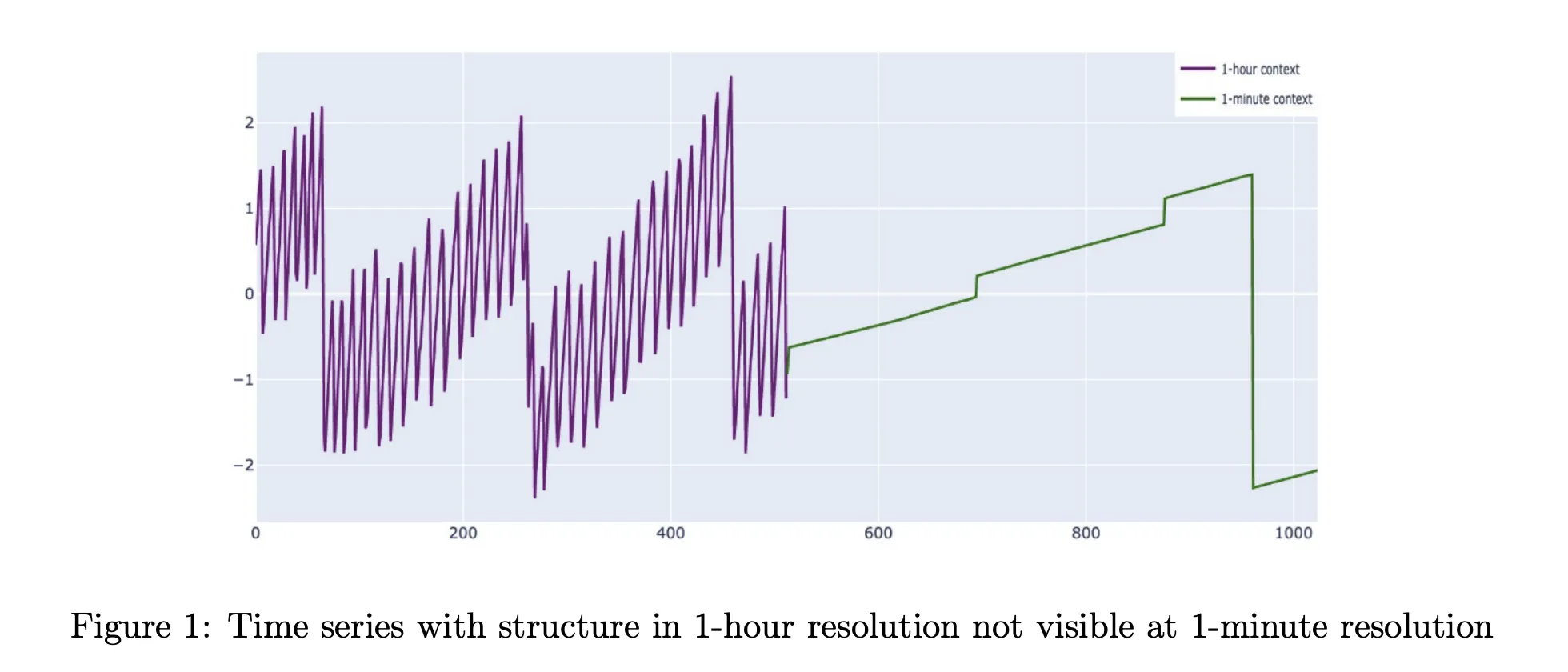
Production metrics are not simple single scale signals. Weekly patterns, long term growth and saturation are visible only at coarse resolutions. Saturation events, traffic spikes and incident dynamics show up at 1 minute or 5 minute resolution. The common time series foundation models work at a single resolution with context windows between 512 and 4096 points, while TimesFM 2.5 extends this to 16384 points. For 1 minute data this still covers at most a couple of weeks and often less.

This is a problem in observability where data platforms often retain only old data in aggregated form. Fine grained samples expire and survive only as 1 hour rollups. Cisco Time Series Model is built for this storage pattern. It treats coarse history as a first class input that improves forecasts at the fine resolution. The architecture operates directly on a multiresolution context instead of pretending that all inputs live on a single grid.

https://arxiv.org/pdf/2511.19841

Multiresolution input and forecasting objective

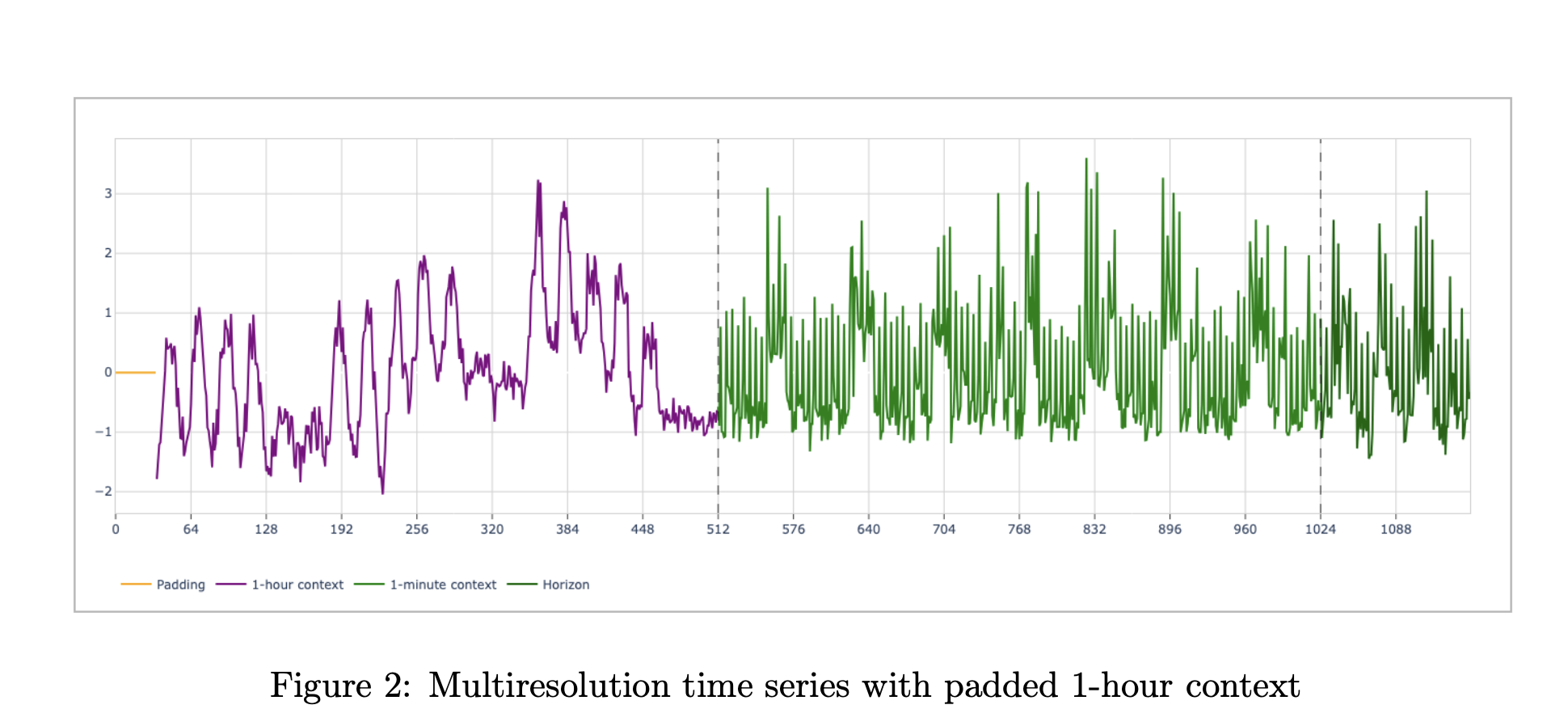
Formally, the model consumes a pair of contexts, (xc, xf). The coarse context (x_c) and the fine context (x_f) each have length up to 512. The spacing of (xc) is fixed at 60 times the spacing of (xf). A typical observability setup uses 512 hours of 1 hour aggregates and 512 minutes of 1 minute values. Both series terminate at the same forecast cut point. The model predicts a horizon of 128 points at the fine resolution, with a mean and a set of quantiles from 0.1 to 0.9.

Architecture, TimesFM core with resolution embeddings

Internally, Cisco Time Series Model reuses the TimesFM patch based decoder stack. The inputs are normalized, patched into non overlapping chunks, and passed through a residual embedding block. The transformer core consists of 50 decoder only layers. A final residual block maps tokens back to the horizon. The research team remove positional embeddings and instead rely on patch ordering, the multiresolution structure and a new resolution embedding to encode structure.

Two additions make the architecture multiresolution aware. A special token, often called ST in the report, is inserted between the coarse and fine token streams. It lives in sequence space and marks the boundary between resolutions. Resolution embeddings, often called RE, are added in model space. One embedding vector is used for all coarse tokens and another for all fine tokens. Ablation studies in the paper show that both components improve quality, especially in long context scenarios.

The decode procedure is also multiresolution. The model outputs mean and quantile forecasts for the fine resolution horizon. During long horizon decoding, newly predicted fine points are appended to the fine context. Aggregates of these predictions update the coarse context. This creates an autoregressive loop in which both resolutions evolve together during forecasting.

https://arxiv.org/pdf/2511.19841

Training data and recipe

Cisco Time Series Model is trained by continued pretraining on top of TimesFM weights. The final model has 500 million parameters. Training uses AdamW for biases, norms and embeddings, and Muon for the hidden layers, with cosine learning rate schedules. The loss combines mean squared error on the mean forecast with quantile loss over the quantiles from 0.1 to 0.9. The team trains for 20 epochs and picks the best checkpoint by validation loss.

The dataset is large and skewed toward observability. The Splunk team reports about 400 million metrics time series from their own Splunk Observability Cloud deployments, collected at 1 minute resolution over 13 months and partly aggregated to 5 minute resolution. The research team states that the final corpus contains more than 300 billion unique data points, with about 35 percent 1 minute observability, 16.5 percent 5 minute observability, 29.5 percent GIFT Eval pretraining data, 4.5 percent Chronos datasets and 14.5 percent synthetic KernelSynth series.

Benchmark results on observability and GIFT Eval

The research team evaluate the model on two main benchmarks. The first is an observability dataset derived from Splunk metrics at 1 minute and 5 minute resolution. The second is a filtered version of GIFT Eval, where datasets that leak TimesFM 2.0 training data are removed.

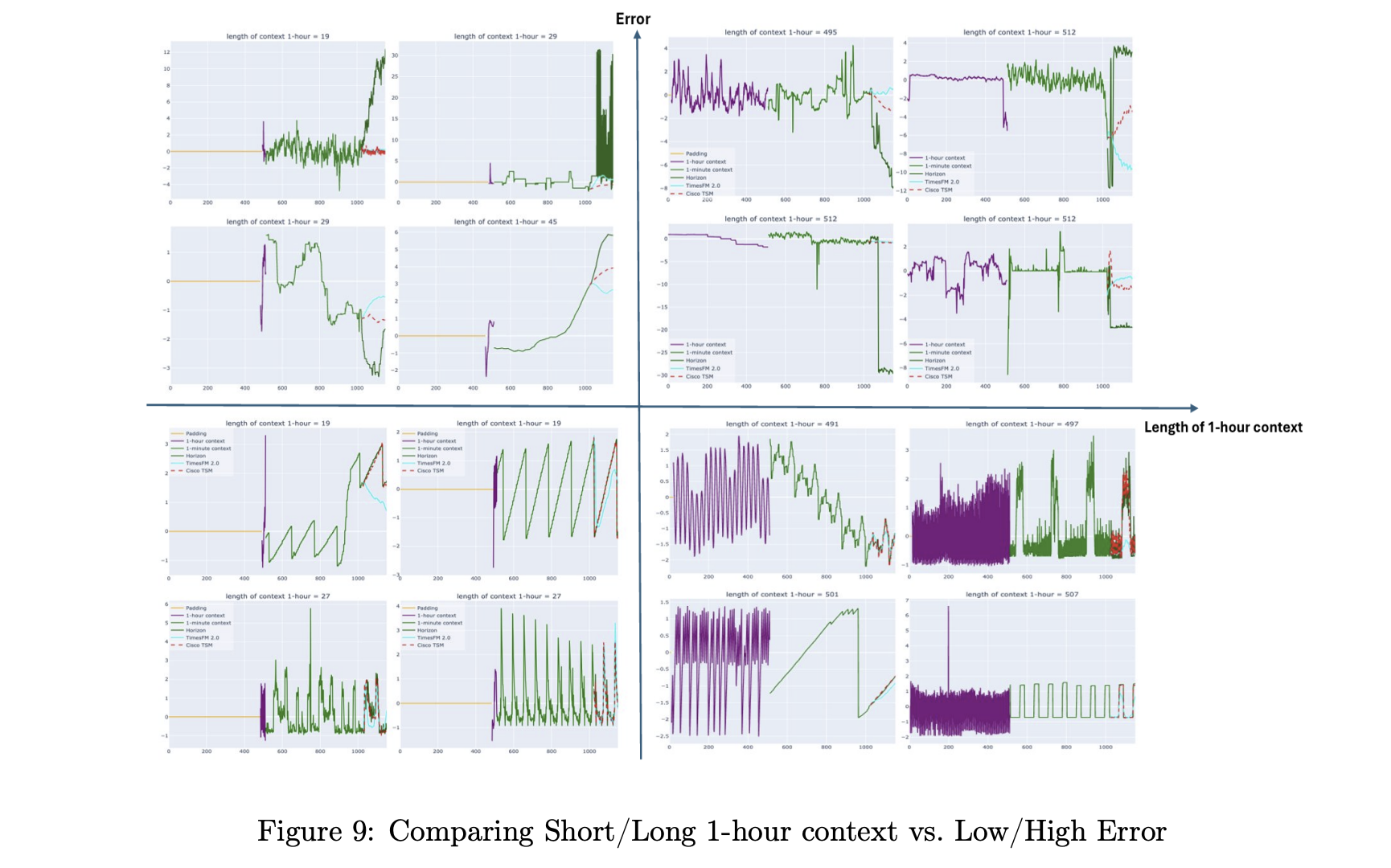
On observability data at 1 minute resolution with 512 fine steps, Cisco Time Series Model using a 512 multiresolution context reduces mean absolute error from 0.6265 for TimesFM 2.5 and 0.6315 for TimesFM 2.0 to 0.4788, with similar improvements in mean absolute scaled error and continuous ranked probability score. Similar gains appear at 5 minute resolution. Across both resolutions, the model outperforms Chronos 2, Chronos Bolt, Toto and AutoARIMA baselines under the normalized metrics used in the paper.

On the filtered GIFT Eval benchmark, Cisco Time Series Model matches the base TimesFM 2.0 model and performs competitively with TimesFM-2.5, Chronos-2 and Toto. The key claim is not universal dominance but preservation of general forecasting quality while adding a strong advantage on long context windows and observability workloads.

https://arxiv.org/pdf/2511.19841

Key Takeaways

  1. Cisco Time Series Model is a univariate zero shot time series foundation model that extends the TimesFM 2.0 decoder only backbone with a multiresolution architecture for observability and security metrics.
  2. The model consumes a multiresolution context, with a coarse series and a fine series, each up to 512 steps long, where the coarse resolution is 60 times the fine resolution, and it predicts 128 fine resolution steps with mean and quantile outputs.
  3. Cisco Time Series Model is trained on more than 300B data points, with more than half from observability, mixing Splunk machine data, GIFT Eval, Chronos datasets and synthetic KernelSynth series, and it has about 0.5B parameters.
  4. On observability benchmarks at 1 minute and 5 minute resolutions, the model achieves lower error than TimesFM 2.0’s, Chronos and other baselines, while retaining competitive performance on the general purpose GIFT Eval benchmark.

Check out the , and . Feel free to check out our . Also, feel free to follow us on  and don’t forget to join our  and Subscribe to . Wait! are you on telegram? 

The post appeared first on .
Read More

A Coding Implementation of a Complete Hierarchical Bayesian Regression Workflow in NumPyro Using JAX-Powered Inference and Posterior Predictive Analysis


In this tutorial, we explore hierarchical Bayesian regression with and walk through the entire workflow in a structured manner. We start by generating synthetic data, then we define a probabilistic model that captures both global patterns and group-level variations. Through each snippet, we set up inference using NUTS, analyze posterior distributions, and perform posterior predictive checks to understand how well our model captures the underlying structure. By approaching the tutorial step by step, we build an intuitive understanding of how NumPyro enables flexible, scalable Bayesian modeling. Check out the .

try:
   import numpyro
except ImportError:
   !pip install -q "llvmlite>=0.45.1" "numpyro[cpu]" matplotlib pandas


import numpy as np
import pandas as pd
import matplotlib.pyplot as plt
import jax
import jax.numpy as jnp
from jax import random
import numpyro
import numpyro.distributions as dist
from numpyro.infer import MCMC, NUTS, Predictive
from numpyro.diagnostics import hpdi


numpyro.set_host_device_count(1)

We set up our environment by installing NumPyro and importing all required libraries. We prepare JAX, NumPyro, and plotting tools so we have everything ready for Bayesian inference. As we run this cell, we ensure our Colab session is fully equipped for hierarchical modeling. Check out the .

def generate_data(key, n_groups=8, n_per_group=40):
   k1, k2, k3, k4 = random.split(key, 4)
   true_alpha = 1.0
   true_beta = 0.6
   sigma_alpha_g = 0.8
   sigma_beta_g = 0.5
   sigma_eps = 0.7
   group_ids = np.repeat(np.arange(n_groups), n_per_group)
   n = n_groups * n_per_group
   alpha_g = random.normal(k1, (n_groups,)) * sigma_alpha_g
   beta_g = random.normal(k2, (n_groups,)) * sigma_beta_g
   x = random.normal(k3, (n,)) * 2.0
   eps = random.normal(k4, (n,)) * sigma_eps
   a = true_alpha + alpha_g[group_ids]
   b = true_beta + beta_g[group_ids]
   y = a + b * x + eps
   df = pd.DataFrame({"y": np.array(y), "x": np.array(x), "group": group_ids})
   truth = dict(true_alpha=true_alpha, true_beta=true_beta,
                sigma_alpha_group=sigma_alpha_g, sigma_beta_group=sigma_beta_g,
                sigma_eps=sigma_eps)
   return df, truth


key = random.PRNGKey(0)
df, truth = generate_data(key)
x = jnp.array(df["x"].values)
y = jnp.array(df["y"].values)
groups = jnp.array(df["group"].values)
n_groups = int(df["group"].nunique())

We generate synthetic hierarchical data that mimics real-world group-level variation. We convert this data into JAX-friendly arrays so NumPyro can process it efficiently. By doing this, we lay the foundation for fitting a model that learns both global trends and group differences. Check out the .

def hierarchical_regression_model(x, group_idx, n_groups, y=None):
   mu_alpha = numpyro.sample("mu_alpha", dist.Normal(0.0, 5.0))
   mu_beta = numpyro.sample("mu_beta", dist.Normal(0.0, 5.0))
   sigma_alpha = numpyro.sample("sigma_alpha", dist.HalfCauchy(2.0))
   sigma_beta = numpyro.sample("sigma_beta", dist.HalfCauchy(2.0))
   with numpyro.plate("group", n_groups):
       alpha_g = numpyro.sample("alpha_g", dist.Normal(mu_alpha, sigma_alpha))
       beta_g = numpyro.sample("beta_g", dist.Normal(mu_beta, sigma_beta))
   sigma_obs = numpyro.sample("sigma_obs", dist.Exponential(1.0))
   alpha = alpha_g[group_idx]
   beta = beta_g[group_idx]
   mean = alpha + beta * x
   with numpyro.plate("data", x.shape[0]):
       numpyro.sample("y", dist.Normal(mean, sigma_obs), obs=y)


nuts = NUTS(hierarchical_regression_model, target_accept_prob=0.9)
mcmc = MCMC(nuts, num_warmup=1000, num_samples=1000, num_chains=1, progress_bar=True)
mcmc.run(random.PRNGKey(1), x=x, group_idx=groups, n_groups=n_groups, y=y)
samples = mcmc.get_samples()

We define our hierarchical regression model and launch the NUTS-based MCMC sampler. We allow NumPyro to explore the posterior space and learn parameters such as group intercepts and slopes. As this sampling completes, we obtain rich posterior distributions that reflect uncertainty at every level. Check out the .

def param_summary(arr):
   arr = np.asarray(arr)
   mean = arr.mean()
   lo, hi = hpdi(arr, prob=0.9)
   return mean, float(lo), float(hi)


for name in ["mu_alpha", "mu_beta", "sigma_alpha", "sigma_beta", "sigma_obs"]:
   m, lo, hi = param_summary(samples[name])
   print(f"{name}: mean={m:.3f}, HPDI=[{lo:.3f}, {hi:.3f}]")


predictive = Predictive(hierarchical_regression_model, samples, return_sites=["y"])
ppc = predictive(random.PRNGKey(2), x=x, group_idx=groups, n_groups=n_groups)
y_rep = np.asarray(ppc["y"])


group_to_plot = 0
mask = df["group"].values == group_to_plot
x_g = df.loc[mask, "x"].values
y_g = df.loc[mask, "y"].values
y_rep_g = y_rep[:, mask]


order = np.argsort(x_g)
x_sorted = x_g[order]
y_rep_sorted = y_rep_g[:, order]
y_med = np.median(y_rep_sorted, axis=0)
y_lo, y_hi = np.percentile(y_rep_sorted, [5, 95], axis=0)


plt.figure(figsize=(8, 5))
plt.scatter(x_g, y_g)
plt.plot(x_sorted, y_med)
plt.fill_between(x_sorted, y_lo, y_hi, alpha=0.3)
plt.show()

We analyze our posterior samples by computing summaries and performing posterior predictive checks. We visualize how well the model recreates observed data for a selected group. This step helps us understand how accurately our model captures the underlying generative process. Check out the .

alpha_g = np.asarray(samples["alpha_g"]).mean(axis=0)
beta_g = np.asarray(samples["beta_g"]).mean(axis=0)


fig, axes = plt.subplots(1, 2, figsize=(12, 4))
axes[0].bar(range(n_groups), alpha_g)
axes[0].axhline(truth["true_alpha"], linestyle="--")
axes[1].bar(range(n_groups), beta_g)
axes[1].axhline(truth["true_beta"], linestyle="--")
plt.tight_layout()
plt.show()

We plot the estimated group-level intercepts and slopes to compare their learned patterns with the true values. We explore how each group behaves and how the model adapts to their differences. This final visualization brings together the complete picture of hierarchical inference.

In conclusion, we implemented how NumPyro allows us to model hierarchical relationships with clarity, efficiency, and strong expressive power. We observed how the posterior results reveal meaningful global and group-specific effects, and how predictive checks validate the model’s fit to the generated data. As we put everything together, we gain confidence in constructing, fitting, and interpreting hierarchical models using JAX-powered inference. This process strengthens our ability to apply Bayesian thinking to richer, more realistic datasets where multilevel structure is essential.


Check out the . Feel free to check out our . Also, feel free to follow us on  and don’t forget to join our  and Subscribe to . Wait! are you on telegram? 

The post appeared first on .
Read More

Microsoft AI Releases VibeVoice-Realtime: A Lightweight Real‑Time Text-to-Speech Model Supporting Streaming Text Input and Robust Long-Form Speech Generation


Microsoft has released , a real time text to speech model that works with streaming text input and long form speech output, aimed at agent style applications and live data narration. The model can start producing audible speech in about 300 ms, which is critical when a language model is still generating the rest of its answer.

Where VibeVoice Realtime Fits in the VibeVoice Stack?

VibeVoice is a broader framework that focuses on next token diffusion over continuous speech tokens, with variants designed for long form multi speaker audio such as podcasts. The research team shows that the main VibeVoice models can synthesize up to 90 minutes of speech with up to 4 speakers in a 64k context window using continuous speech tokenizers at 7.5 Hz.

The Realtime 0.5B variant is the low latency branch of this family. The model card reports an 8k context length and a typical generation length of about 10 minutes for a single speaker, which is enough for most voice agents, system narrators and live dashboards. A separate set of VibeVoice models, VibeVoice-1.5B and VibeVoice Large, handle long form multi speaker audio with 32k and 64k context windows and longer generation times.

Interleaved Streaming Architecture

The realtime variant uses an interleaved windowed design. Incoming text is split into chunks. The model incrementally encodes new text chunks while, in parallel, continuing diffusion based acoustic latent generation from prior context. This overlap between text encoding and acoustic decoding is what lets the system reach about 300 ms first audio latency on suitable hardware.

Unlike the long form VibeVoice variants, which use both semantic and acoustic tokenizers, the realtime model removes the semantic tokenizer and uses only an acoustic tokenizer that operates at 7.5 Hz. The acoustic tokenizer is based on a σ VAE variant from LatentLM, with a mirror symmetric encoder decoder architecture that uses 7 stages of modified transformer blocks and performs 3200x downsampling from 24 kHz audio.

On top of this tokenizer, a diffusion head predicts acoustic VAE features. The diffusion head has 4 layers and about 40M parameters and is conditioned on hidden states from Qwen2.5-0.5B. It uses a Denoising Diffusion Probabilistic Models process with Classifier Free Guidance and DPM Solver style samplers, following the next token diffusion approach of the full VibeVoice system.

Training proceeds in two stages. First, the acoustic tokenizer is pre trained. Then the tokenizer is frozen and the team trains the LLM along with the diffusion head with curriculum learning on sequence length, increasing from about 4k to 8,192 tokens. This keeps the tokenizer stable, while the LLM and diffusion head learn to map from text tokens to acoustic tokens across long contexts.

Quality on LibriSpeech and SEED

The VibeVoice Realtime reports zero shot performance on LibriSpeech test clean. VibeVoice Realtime 0.5B reaches word error rate (WER) 2.00 percent and speaker similarity 0.695. For comparison, VALL-E 2 has WER 2.40 with similarity 0.643 and Voicebox has WER 1.90 with similarity 0.662 on the same benchmark.

On the SEED test benchmark for short utterances, VibeVoice Realtime-0.5B reaches WER 2.05 percent and speaker similarity 0.633. SparkTTS gets a slightly lower WER 1.98 but lower similarity 0.584, while Seed TTS reaches WER 2.25 and the highest reported similarity 0.762. The research team noted that the realtime model is optimized for long form robustness, so short sentence metrics are informative but not the main target.

From an engineering point of view, the interesting part is the tradeoff. By running the acoustic tokenizer at 7.5 Hz and using next token diffusion, the model reduces the number of steps per second of audio compared to higher frame rate tokenizers, while preserving competitive WER and speaker similarity.

Integration Pattern for Agents And Applications

The recommended setup is to run VibeVoice-Realtime-0.5B next to a conversational LLM. The LLM streams tokens during generation. These text chunks feed directly into the VibeVoice server, which synthesizes audio in parallel and streams it back to the client.

For many systems this looks like a small microservice. The TTS process has a fixed 8k context and about 10 minutes of audio budget per request, which fits typical agent dialogs, support calls and monitoring dashboards. Because the model is speech only and does not generate background ambience or music, it is better suited for voice interfaces, assistant style products and programmatic narration rather than media production.

Key Takeaways

  1. Low latency streaming TTS: VibeVoice-Realtime-0.5B is a real time text to speech model that supports streaming text input and can emit the first audio frames in about 300 ms, which makes it suitable for interactive agents and live narration where users cannot tolerate 1 to 3 second delays.
  2. LLM along with diffusion over continuous speech tokens: The model follows the VibeVoice design, it uses a Qwen2.5 0.5B language model to process text context and dialogue flow, then a diffusion head operates on continuous acoustic tokens from a low frame rate tokenizer to generate waveform level detail, which scales better to long sequences than classic spectrogram based TTS.
  3. Around 1B total parameters with acoustic stack: While the base LLM has 0.5B parameters, the acoustic decoder has about 340M parameters and the diffusion head about 40M parameters, so the full realtime stack is roughly 1B parameters, which is important for GPU memory planning and deployment sizing.
  4. Competitive quality on LibriSpeech and SEED: On LibriSpeech test clean, VibeVoice-Realtime-0.5B reaches word error rate 2.00 percent and speaker similarity 0.695, and on SEED test en it reaches 2.05 percent WER and 0.633 similarity, which places it in the same quality band as strong recent TTS systems while still being tuned for long form robustness.

Check out the . Feel free to check out our . Also, feel free to follow us on  and don’t forget to join our  and Subscribe to . Wait! are you on telegram? 

The post appeared first on .

Read More

How to Build an Adaptive Meta-Reasoning Agent That Dynamically Chooses Between Fast, Deep, and Tool-Based Thinking Strategies


We begin this tutorial by building a meta-reasoning agent that decides how to think before it thinks. Instead of applying the same reasoning process for every query, we design a system that evaluates complexity, chooses between fast heuristics, deep chain-of-thought reasoning, or tool-based computation, and then adapts its behaviour in real time. By examining each component, we understand how an intelligent agent can regulate its cognitive effort, balance speed and accuracy, and follow a strategy that aligns with the problem’s nature. By doing this, we experience the shift from reactive answering to strategic reasoning. Check out the .

import re
import time
import random
from typing import Dict, List, Tuple, Literal
from dataclasses import dataclass, field


@dataclass
class QueryAnalysis:
   query: str
   complexity: Literal["simple", "medium", "complex"]
   strategy: Literal["fast", "cot", "tool"]
   confidence: float
   reasoning: str
   execution_time: float = 0.0
   success: bool = True


class MetaReasoningController:
   def __init__(self):
       self.query_history: List[QueryAnalysis] = []
       self.patterns = {
           'math': r'(d+s*[+-*/]s*d+)|calculate|compute|sum|product',
           'search': r'current|latest|news|today|who is|what is.*now',
           'creative': r'write|poem|story|joke|imagine',
           'logical': r'if.*then|because|therefore|prove|explain why',
           'simple_fact': r'^(what|who|when|where) (is|are|was|were)',
       }


   def analyze_query(self, query: str) -> QueryAnalysis:
       query_lower = query.lower()
       has_math = bool(re.search(self.patterns['math'], query_lower))
       needs_search = bool(re.search(self.patterns['search'], query_lower))
       is_creative = bool(re.search(self.patterns['creative'], query_lower))
       is_logical = bool(re.search(self.patterns['logical'], query_lower))
       is_simple = bool(re.search(self.patterns['simple_fact'], query_lower))
       word_count = len(query.split())
       has_multiple_parts = '?' in query[:-1] or ';' in query


       if has_math:
           complexity = "medium"
           strategy = "tool"
           reasoning = "Math detected - using calculator tool for accuracy"
           confidence = 0.9
       elif needs_search:
           complexity = "medium"
           strategy = "tool"
           reasoning = "Current/dynamic info - needs search tool"
           confidence = 0.85
       elif is_simple and word_count < 10:
           complexity = "simple"
           strategy = "fast"
           reasoning = "Simple factual query - fast retrieval sufficient"
           confidence = 0.95
       elif is_logical or has_multiple_parts or word_count > 30:
           complexity = "complex"
           strategy = "cot"
           reasoning = "Complex reasoning required - using chain-of-thought"
           confidence = 0.8
       elif is_creative:
           complexity = "medium"
           strategy = "cot"
           reasoning = "Creative task - chain-of-thought for idea generation"
           confidence = 0.75
       else:
           complexity = "medium"
           strategy = "cot"
           reasoning = "Unclear complexity - defaulting to chain-of-thought"
           confidence = 0.6


       return QueryAnalysis(query, complexity, strategy, confidence, reasoning)

We set up the core structures that allow our agent to analyze incoming queries. We define how we classify complexity, detect patterns, and decide the reasoning strategy. As we build this foundation, we create the brain that determines how we think before we answer. Check out the .

class FastHeuristicEngine:
   def __init__(self):
       self.knowledge_base = {
           'capital of france': 'Paris',
           'capital of spain': 'Madrid',
           'speed of light': '299,792,458 meters per second',
           'boiling point of water': '100°C or 212°F at sea level',
       }
   def answer(self, query: str) -> str:
       q = query.lower()
       for k, v in self.knowledge_base.items():
           if k in q:
               return f"Answer: {v}"
       if 'hello' in q or 'hi' in q:
           return "Hello! How can I help you?"
       return "Fast heuristic: No direct match found."


class ChainOfThoughtEngine:
   def answer(self, query: str) -> str:
       s = []
       s.append("Step 1: Understanding the question")
       s.append(f"  → The query asks about: {query[:50]}...")
       s.append("nStep 2: Breaking down the problem")
       if 'why' in query.lower():
           s.append("  → This is a causal question requiring explanation")
           s.append("  → Need to identify causes and effects")
       elif 'how' in query.lower():
           s.append("  → This is a procedural question")
           s.append("  → Need to outline steps or mechanisms")
       else:
           s.append("  → Analyzing key concepts and relationships")
       s.append("nStep 3: Synthesizing answer")
       s.append("  → Combining insights from reasoning steps")
       s.append("nStep 4: Final answer")
       s.append("  → [Detailed response based on reasoning chain]")
       return "n".join(s)


class ToolExecutor:
   def calculate(self, expression: str) -> float:
       m = re.search(r'(d+.?d*)s*([+-*/])s*(d+.?d*)', expression)
       if m:
           a, op, b = m.groups()
           a, b = float(a), float(b)
           ops = {
               '+': lambda x, y: x + y,
               '-': lambda x, y: x - y,
               '*': lambda x, y: x * y,
               '/': lambda x, y: x / y if y != 0 else float('inf'),
           }
           return ops[op](a, b)
       return None


   def search(self, query: str) -> str:
       return f"[Simulated search results for: {query}]"


   def execute(self, query: str, tool_type: str) -> str:
       if tool_type == "calculator":
           r = self.calculate(query)
           if r is not None:
               return f"Calculator result: {r}"
           return "Could not parse mathematical expression"
       elif tool_type == "search":
           return self.search(query)
       return "Tool execution completed"

We develop the engines that actually perform the thinking. We design a fast heuristic module for simple lookups, a chain-of-thought engine for deeper reasoning, and tool functions for computation or search. As we implement these components, we prepare the agent to switch flexibly between different modes of intelligence. Check out the .

class MetaReasoningAgent:
   def __init__(self):
       self.controller = MetaReasoningController()
       self.fast_engine = FastHeuristicEngine()
       self.cot_engine = ChainOfThoughtEngine()
       self.tool_executor = ToolExecutor()
       self.stats = {
           'fast': {'count': 0, 'total_time': 0},
           'cot': {'count': 0, 'total_time': 0},
           'tool': {'count': 0, 'total_time': 0},
       }


   def process_query(self, query: str, verbose: bool = True) -> str:
       if verbose:
           print("n" + "="*60)
           print(f"QUERY: {query}")
           print("="*60)
       t0 = time.time()
       analysis = self.controller.analyze_query(query)


       if verbose:
           print(f"n🧠 META-REASONING:")
           print(f"   Complexity: {analysis.complexity}")
           print(f"   Strategy: {analysis.strategy.upper()}")
           print(f"   Confidence: {analysis.confidence:.2%}")
           print(f"   Reasoning: {analysis.reasoning}")
           print(f"n⚡ EXECUTING {analysis.strategy.upper()} STRATEGY...n")


       if analysis.strategy == "fast":
           resp = self.fast_engine.answer(query)
       elif analysis.strategy == "cot":
           resp = self.cot_engine.answer(query)
       elif analysis.strategy == "tool":
           if re.search(self.controller.patterns['math'], query.lower()):
               resp = self.tool_executor.execute(query, "calculator")
           else:
               resp = self.tool_executor.execute(query, "search")


       dt = time.time() - t0
       analysis.execution_time = dt
       self.stats[analysis.strategy]['count'] += 1
       self.stats[analysis.strategy]['total_time'] += dt
       self.controller.query_history.append(analysis)


       if verbose:
           print(resp)
           print(f"n⏱  Execution time: {dt:.4f}s")
       return resp


   def show_stats(self):
       print("n" + "="*60)
       print("AGENT PERFORMANCE STATISTICS")
       print("="*60)
       for s, d in self.stats.items():
           if d['count'] > 0:
               avg = d['total_time'] / d['count']
               print(f"n{s.upper()} Strategy:")
               print(f"  Queries processed: {d['count']}")
               print(f"  Average time: {avg:.4f}s")
       print("n" + "="*60)

We bring all components together into a unified agent. We orchestrate the flow from meta-reasoning to execution, track performance, and observe how each strategy behaves. As we run this system, we see our agent deciding, reasoning, and adapting in real time. Check out the .

def run_tutorial():
   print("""
   META-REASONING AGENT TUTORIAL
   "When Should I Think Hard vs Answer Fast?"


   This agent demonstrates:
   1. Fast vs deep vs tool-based reasoning
   2. Choosing cognitive strategy
   3. Adaptive intelligence
   """)


   agent = MetaReasoningAgent()
   test_queries = [
       "What is the capital of France?",
       "Calculate 156 * 23",
       "Why do birds migrate south for winter?",
       "What is the latest news today?",
       "Hello!",
       "If all humans need oxygen and John is human, what can we conclude?",
   ]


   for q in test_queries:
       agent.process_query(q, verbose=True)
       time.sleep(0.5)


   agent.show_stats()
   print("nTutorial complete!")
   print("• Meta-reasoning chooses how to think")
   print("• Different queries need different strategies")
   print("• Smart agents adapt reasoning dynamicallyn")

We built a demo runner to showcase the agent’s capabilities. We feed it diverse queries and watch how it selects its strategy and generates responses. As we interact with it, we experience the benefits of adaptive reasoning firsthand. Check out the .

if __name__ == "__main__":
   run_tutorial()

We initialize the entire tutorial with a simple main block. We run the demonstration and observe the full meta-reasoning pipeline in action. As we execute this, we complete the journey from design to a fully functioning adaptive agent.

In conclusion, we see how building a meta-reasoning agent allows us to move beyond fixed-pattern responses and toward adaptive intelligence. We observe how the agent analyzes each query, selects the most appropriate reasoning mode, and executes it efficiently while tracking its own performance. By designing and experimenting with these components, we gain practical insight into how advanced agents can self-regulate their thinking, optimize effort, and deliver better outcomes.


Check out the . Feel free to check out our . Also, feel free to follow us on  and don’t forget to join our  and Subscribe to . Wait! are you on telegram? 

The post appeared first on .
Read More
OpenAGI Foundation Launches Lux: A Foundation Computer Use Model that Tops Online Mind2Web with OSGym At Scale

OpenAGI Foundation Launches Lux: A Foundation Computer Use Model that Tops Online Mind2Web with OSGym At Scale


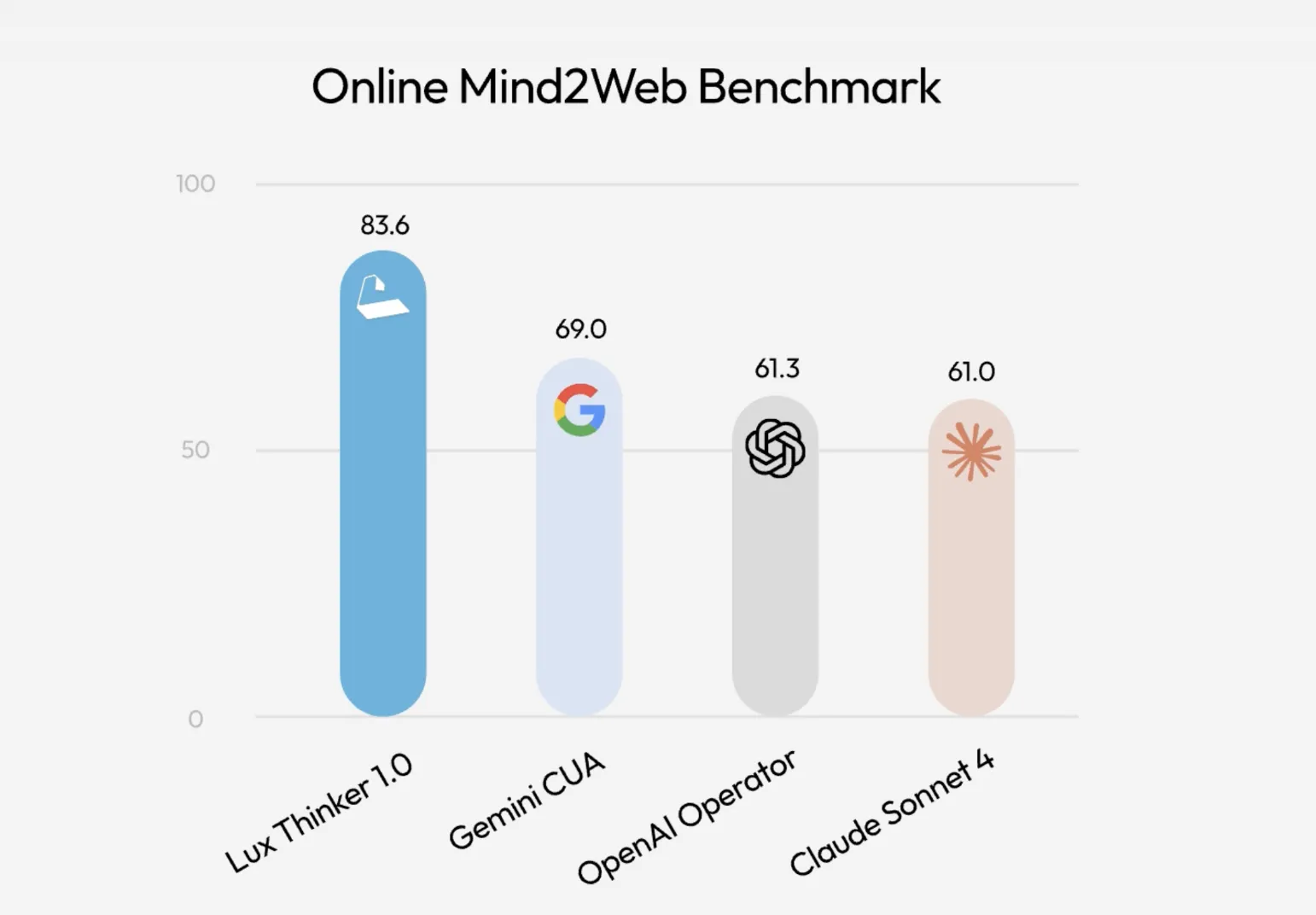
How do you turn slow, manual click work across browsers and desktops into a reliable, automated system that can actually use a computer for you at scale? Lux is the latest example of computer use agents moving from research demo to infrastructure. OpenAGI Foundation team has released Lux, a foundation model that operates real desktops and browsers and reports a score of 83.6 on the Online Mind2Web benchmark, which covers more than 300 real world computer use tasks. This is ahead of Google Gemini CUA at 69.0, OpenAI Operator at 61.3 and Anthropic Claude Sonnet 4 at 61.0.

https://agiopen.org/blog

What Lux Actually Does?

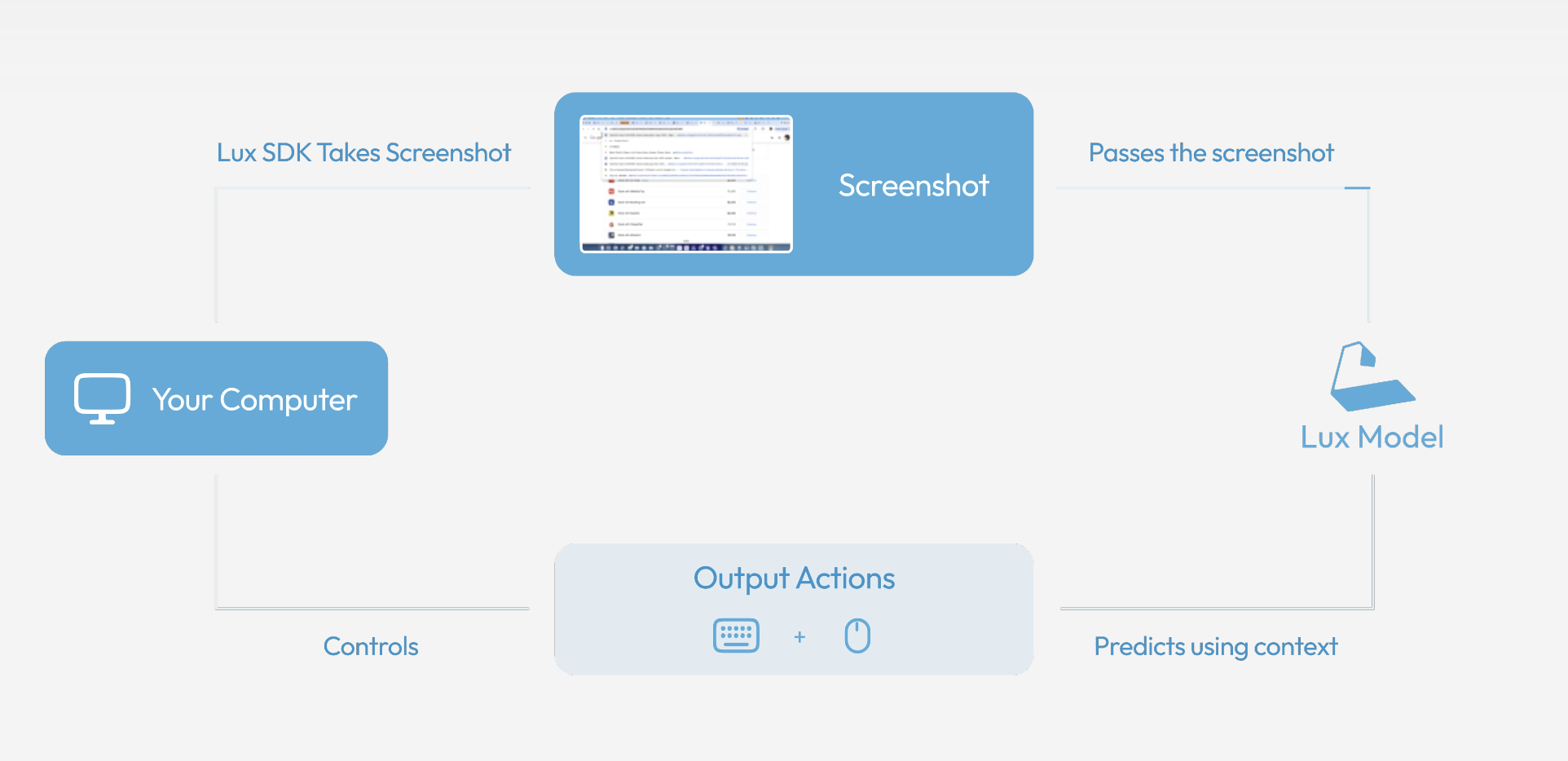
Lux is a computer use model, not a chat model with a browser plugin. It takes a natural language goal, views the screen, and outputs low level actions such as clicks, key presses and scroll events. It can drive browsers, editors, spreadsheets, email clients and other desktop applications because it works on rendered UI, not on application specific APIs.

From a developer point of view, Lux is available through the OpenAGI SDK and API console. The research team describes target workloads that include software QA flows, deep research runs, social media management, online store operations and bulk data entry. In all of these settings the agent needs to sequence dozens or hundreds of UI actions while staying aligned with a natural language task description.

https://agiopen.org/blog

Three Execution Modes For Different Control Levels

Lux ships with three execution modes that expose different tradeoffs between speed, autonomy and control.

Actor mode is the fast path. It runs around 1 second per step and is aimed at clearly specified tasks such as filling a form, pulling a report from a dashboard or extracting a small set of fields from a page. Think of it as a low latency macro engine that still understands natural language.

Thinker mode handles vague or multi step goals. It decomposes the high level instruction into smaller sub tasks and then executes them. Example workloads include multi page research, triage of long email queues or navigation of analytics interfaces where the exact click path is not specified in advance.

Tasker mode gives maximum determinism. The caller supplies an explicit Python list of steps that Lux executes one by one and it retries until the sequence completes or hits a hard failure. This allows teams to keep task graphs, guardrails and failure policies in their own code while delegating UI control to the model.

Tasker, Actor and Thinker are the three primary modes for procedural workflows, fast execution and complex goal solving.

Benchmarks, Latency And Cost

On Online Mind2Web, Lux reaches a success rate of 83.6 percent. The same benchmark reports 69.0 percent for Gemini CUA, 61.3 percent for OpenAI Operator and 61.0 percent for Claude Sonnet 4. The benchmark contains more than 300 web based tasks collected from real services, so it is a useful proxy for practical agents that drive browsers and web apps.

Latency and cost are where the numbers become important for engineering teams. OpenAGI team reports that Lux completes each step in about 1 second, while OpenAI Operator is around 3 seconds per step in the same evaluation setting. The research team also states that Lux is about 10 times cheaper per token than Operator. For any agent that can easily run hundreds of steps in a session, these constant factors determine whether a workload is viable in production.

Agentic Active Pre-training and Why OSGym Matters?

Lux is trained with a method that OpenAGI research team calls Agentic Active Pre-training. The team contrasts this with standard language model pre-training that passively ingests text from the internet. The idea is that Lux learns by acting in digital environments and refining its behavior through large scale interaction, rather than only minimizing token prediction loss on static logs. The optimization objective differs from classical reinforcement learning, and is set up to favor self driven exploration and understanding instead of a manually shaped reward.

This training setup depends on a data engine that can expose many operating system environments in parallel. OpenAGI team has already open sourced that engine as , under an MIT license that allows both research and commercial use. OSGym runs full operating system replicas, not only browser sandboxes, and supports tasks that span office software, browsers, development tools and multi application workflows.

Key Takeaways

  1. Lux is a foundation computer use model that operates full desktops and browsers and reaches 83.6 percent success on the Online Mind2Web benchmark, ahead of Gemini CUA, OpenAI Operator and Claude Sonnet-4.
  2. Lux exposes 3 modes, Actor, Thinker and Tasker, which cover low latency UI macros, multi step goal decomposition and deterministic scripted execution for production workflows.
  3. Lux is reported to run around 1 second per step and to be about 10 times cheaper per token than OpenAI Operator, which matters for long horizon agents that run hundreds of actions per task.
  4. Lux is trained with Agentic Active Pre-training, where the model learns by acting in environments, rather than only consuming static web text, which targets robust screen to action behavior instead of pure language modeling.
  5. OSGym, the open source data engine behind Lux, can run more than 1,000 OS replicas and generate more than 1,400 multi turn trajectories per minute at low per replica cost, which gives teams a practical way to train and evaluate their own computer use agents.

Check out the , and . Feel free to check out our . Also, feel free to follow us on  and don’t forget to join our  and Subscribe to . Wait! are you on telegram? 

The post appeared first on .

Read More
Apple Researchers Release CLaRa: A Continuous Latent Reasoning Framework for Compression‑Native RAG with 16x–128x Semantic Document Compression

Apple Researchers Release CLaRa: A Continuous Latent Reasoning Framework for Compression‑Native RAG with 16x–128x Semantic Document Compression


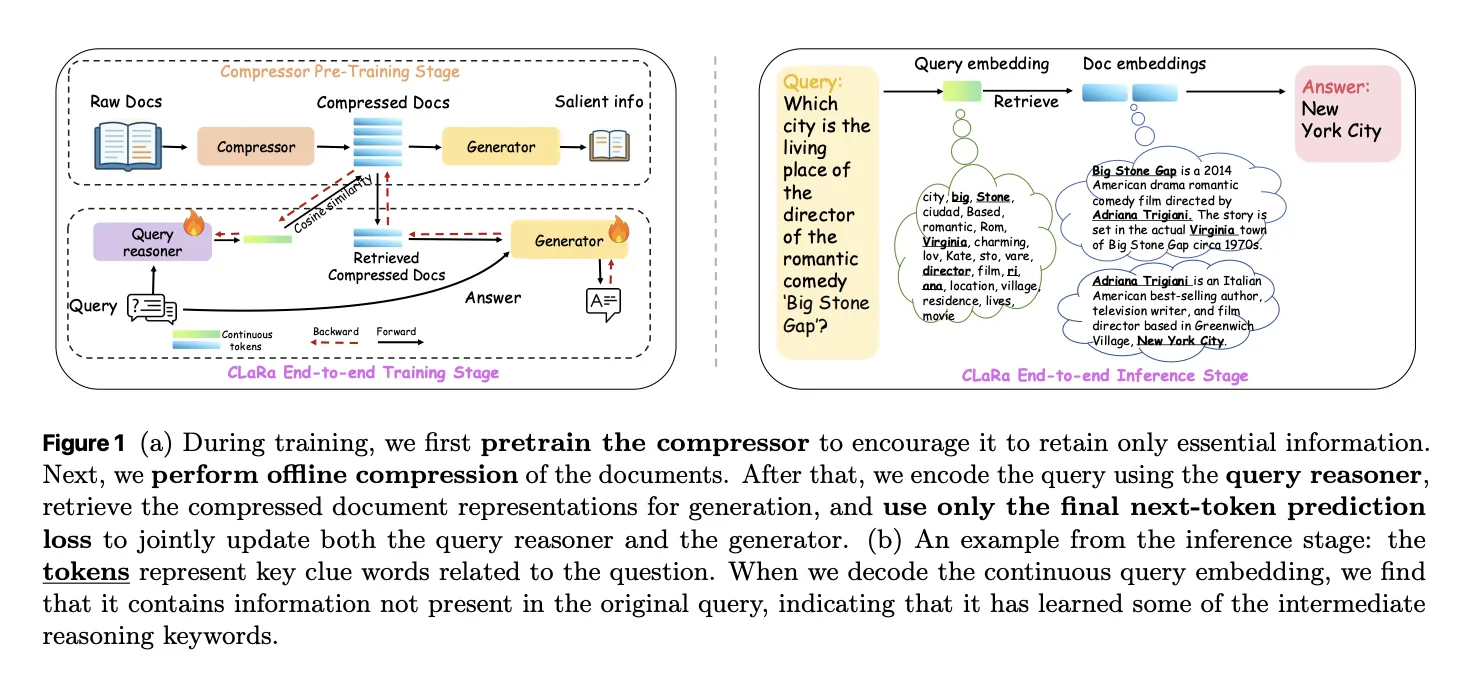
How do you keep RAG systems accurate and efficient when every query tries to stuff thousands of tokens into the context window and the retriever and generator are still optimized as 2 separate, disconnected systems? A team of researchers from Apple and University of Edinburgh released CLaRa, Continuous Latent Reasoning, (CLaRa-7B-Base, CLaRa-7B-Instruct and CLaRa-7B-E2E) a retrieval augmented generation framework that compresses documents into continuous memory tokens and then performs both retrieval and generation in that shared latent space. The goal is simple. Shorten context, avoid double encoding, and let the generator teach the retriever what actually matters for downstream answers.

https://arxiv.org/pdf/2511.18659

From raw documents to continuous memory tokens

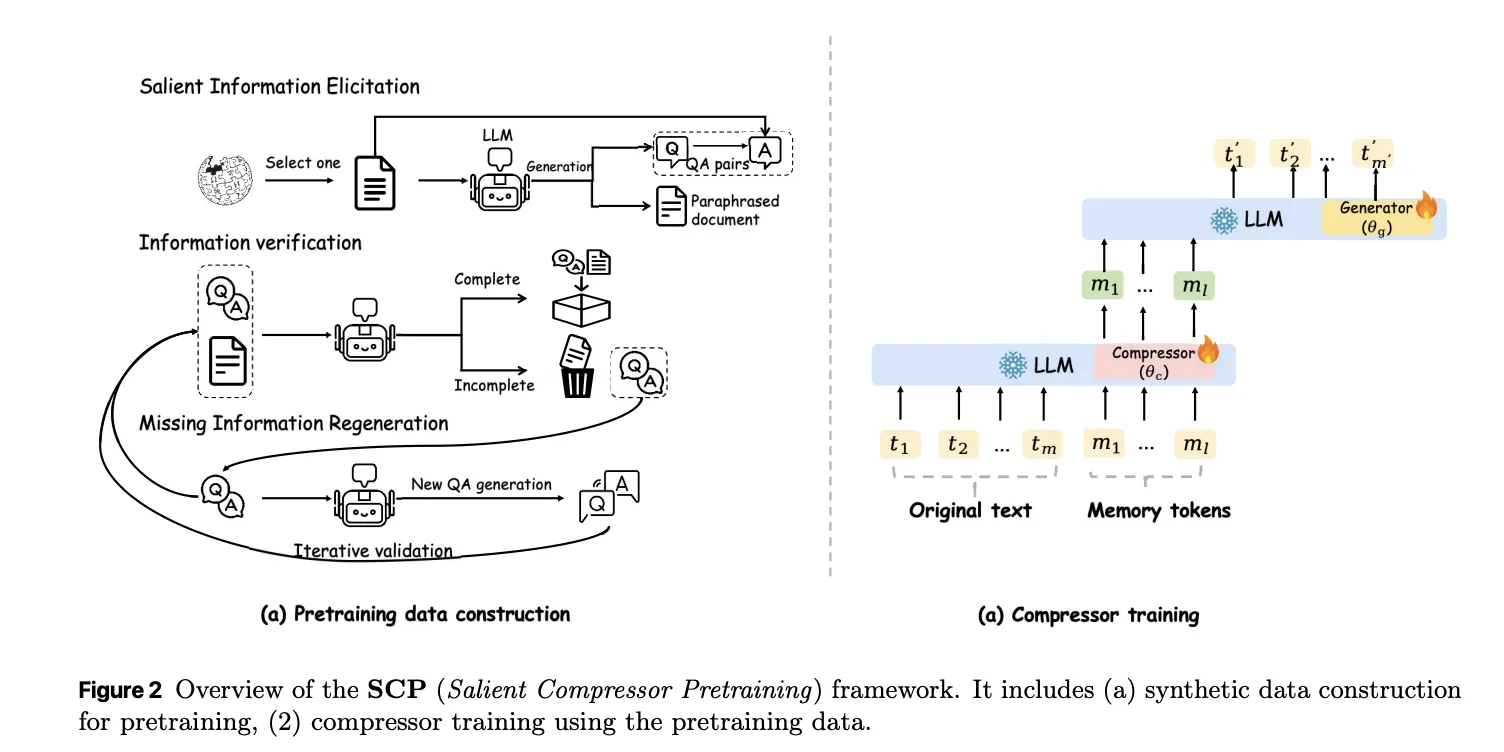
CLaRa starts with a semantic compressor that attaches a small number of learned memory tokens to each document. During Salient Compressor Pretraining, SCP, the base model is a Mistral 7B style transformer with LoRA adapters that switch between a compressor role and a generator role. The final layer hidden states of the memory tokens become the compressed representation for that document.

SCP is trained on about 2M passages from Wikipedia 2021. A local Qwen-32B model generates 3 supervision signals for each passage. Simple QA pairs cover atomic facts. Complex QA pairs connect several facts in one question to enforce multi hop reasoning. Paraphrases reorder and compress the text while preserving semantics. A verification loop checks factual consistency and coverage and can regenerate missing questions or paraphrases for up to 10 rounds before accepting a sample.

Training uses 2 losses. A cross entropy term trains the generator to answer questions or produce paraphrases conditioned only on the memory tokens and an instruction prefix. A mean squared error term aligns the average hidden state of document tokens with the average hidden state of the memory tokens. The MSE loss gives modest but consistent gains of about 0.3 to 0.6 F1 points at compression ratios 32 and 128 and keeps compressed and original representations in the same semantic region.

https://arxiv.org/pdf/2511.18659

Joint retrieval and generation in a shared space

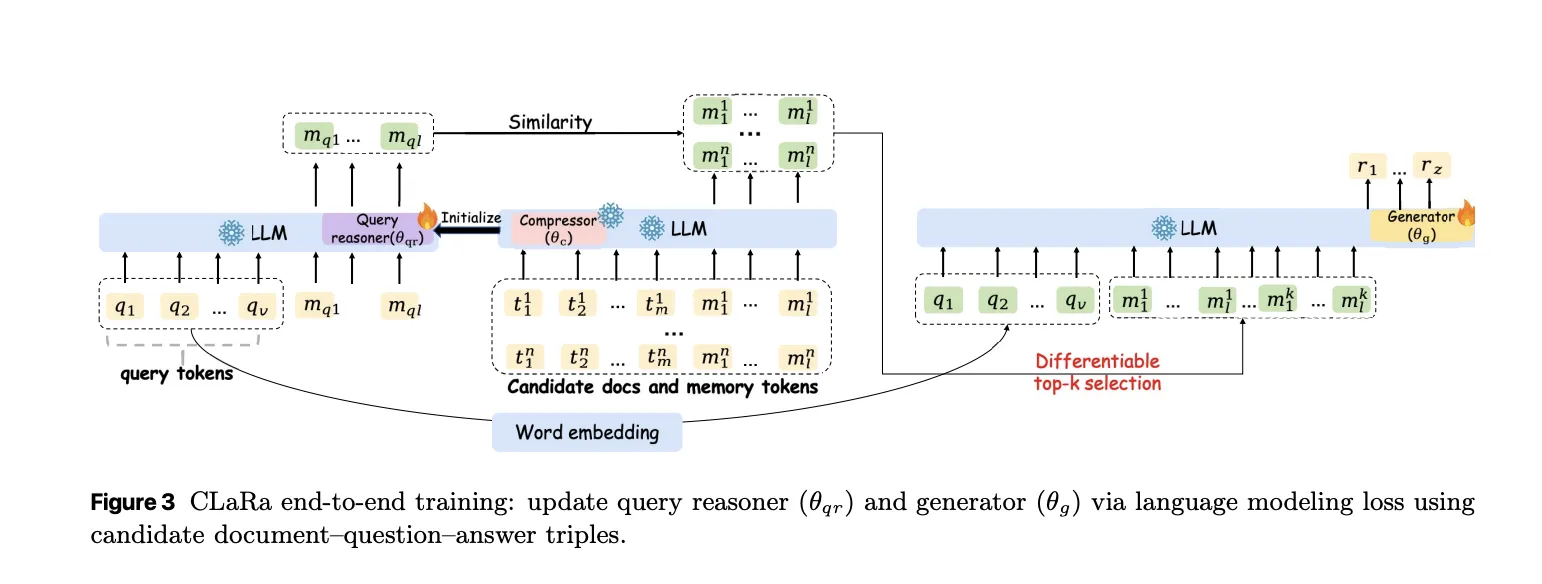
After offline compression, each document is represented only by its memory tokens. CLaRa then trains a query reasoner and an answer generator on top of the same backbone. The query reasoner is another LoRA adapter that maps an input question into the same number of memory tokens used for documents. Retrieval becomes pure embedding search. The system computes cosine similarity between the query embedding and each candidate document embedding.

The best compressed document embeddings for a query are concatenated with the query tokens and fed into the generator adapter. Training uses only a standard next token prediction loss on the final answer. There are no explicit relevance labels. The key trick is a differentiable top k selector implemented with a Straight Through estimator. During the forward pass the model uses hard top k selection. During the backward pass a softmax distribution over document scores allows gradients from the generator to flow into the query reasoner parameters.

The research team shows 2 effects in the gradient analysis. First, the retriever is encouraged to assign higher probability to documents that increase answer likelihood. Second, because retrieval and generation share the same compressed representations, generator gradients reshape the latent document space to make it easier to reason over. Logit lens analysis of the query embeddings recovers topic tokens such as “NFL” and “Oklahoma” for a question about the nephew of Ivory Lee Brown, even though those tokens are not in the raw query but are present in the supporting articles.

https://arxiv.org/pdf/2511.18659

Compression quality and QA accuracy

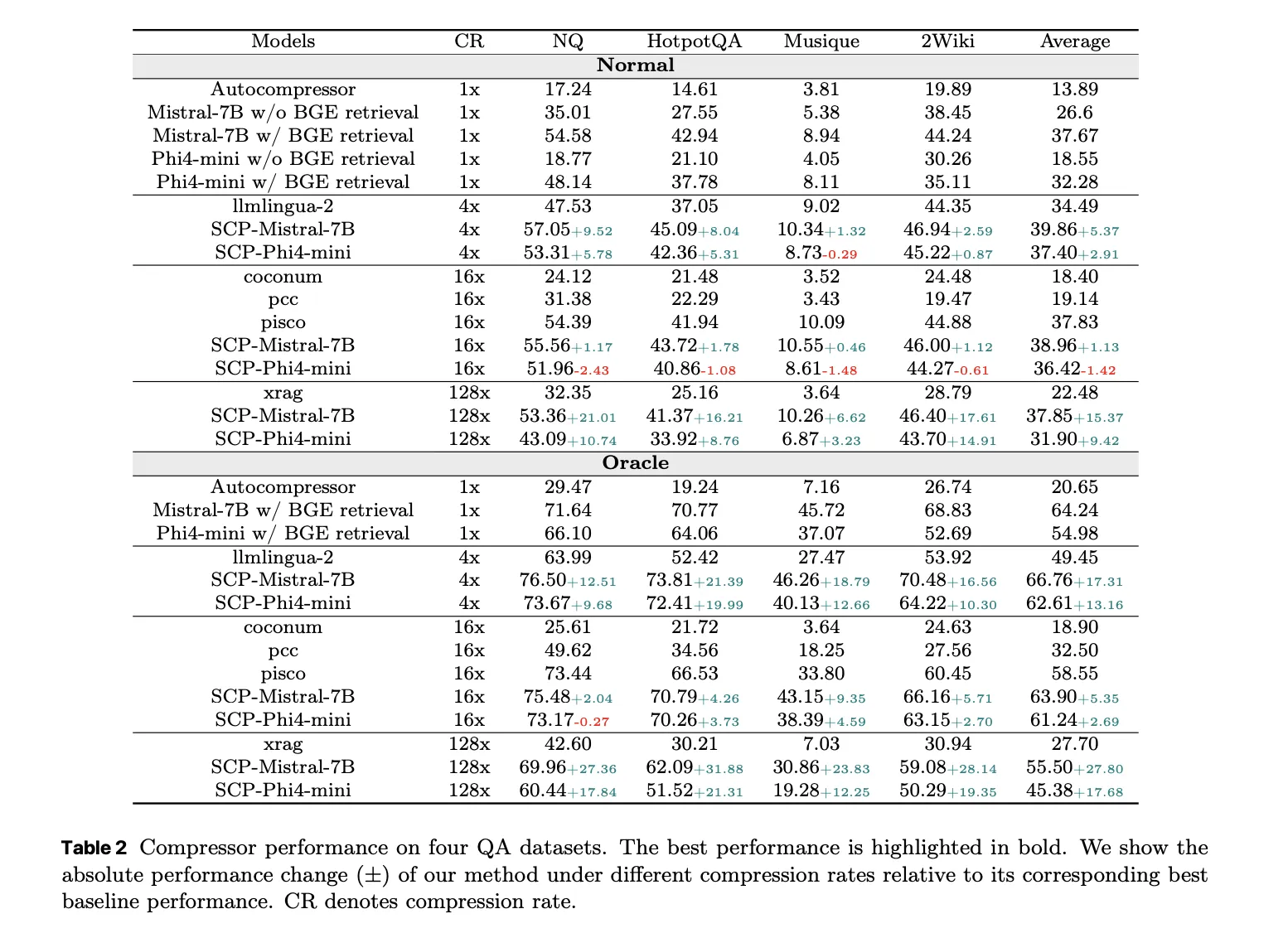
The compressor is evaluated on 4 QA datasets: Natural Questions, HotpotQA, MuSiQue and 2WikiMultihopQA. Under the Normal setting, where the system retrieves the top 5 Wikipedia 2021 documents per query, SCP-Mistral-7B at 4 times compression reaches an average F1 of 39.86. This is 5.37 points better than the hard compression baseline LLMLingua 2 and 1.13 points better than the best soft compression baseline PISCO.

Under the Oracle setting, where the gold document is guaranteed to be in the candidate set, SCP-Mistral-7B at 4 times compression reaches an average F1 of 66.76. That is 17.31 points above LLMLingua-2 and 5.35 points above PISCO. Even more interesting, the compressed representations outperform a BGE based text retriever plus full document Mistral-7B generator by about 2.36 average F1 points for Mistral and about 6.36 points for Phi 4 mini. Well trained soft compression can exceed full text RAG while cutting context length by factors from 4 to 128.

https://arxiv.org/pdf/2511.18659

The performance at very high compression ratios, above 32 in Oracle, does drop, but the decline remains moderate in Normal retrieval conditions. The key explanation as per the research team is, weak document relevance bottlenecks the system before compression quality does.

End to end QA and retrieval behavior

For end to end QA, CLaRa uses 20 candidate documents per query with compression ratios 4, 16 and 32. On the Normal setting, CLaRa-Mistral-7B with instruction initialized weights and 16 times compression reaches F1 equal to 50.89 on Natural Questions and 44.66 on 2WikiMultihopQA. This is comparable to DRO-Mistral-7B, which reads full uncompressed text, while using 16 times shorter document representations. On some datasets, CLaRa at 16 times compression slightly improves F1 over DRO, for example from 43.65 to 47.18 on 2Wiki.

In the Oracle setting, CLaRa-Mistral-7B exceeds 75, F1 on both Natural Questions and HotpotQA at 4 times compression. This shows that the generator can fully exploit accurate retrieval even when all evidence is stored only in compressed memory tokens. Instruction initialized CLaRa generally wins over pre-training initialized CLaRa in the Normal setting, while the gap narrows in Oracle, where retrieval noise is limited.

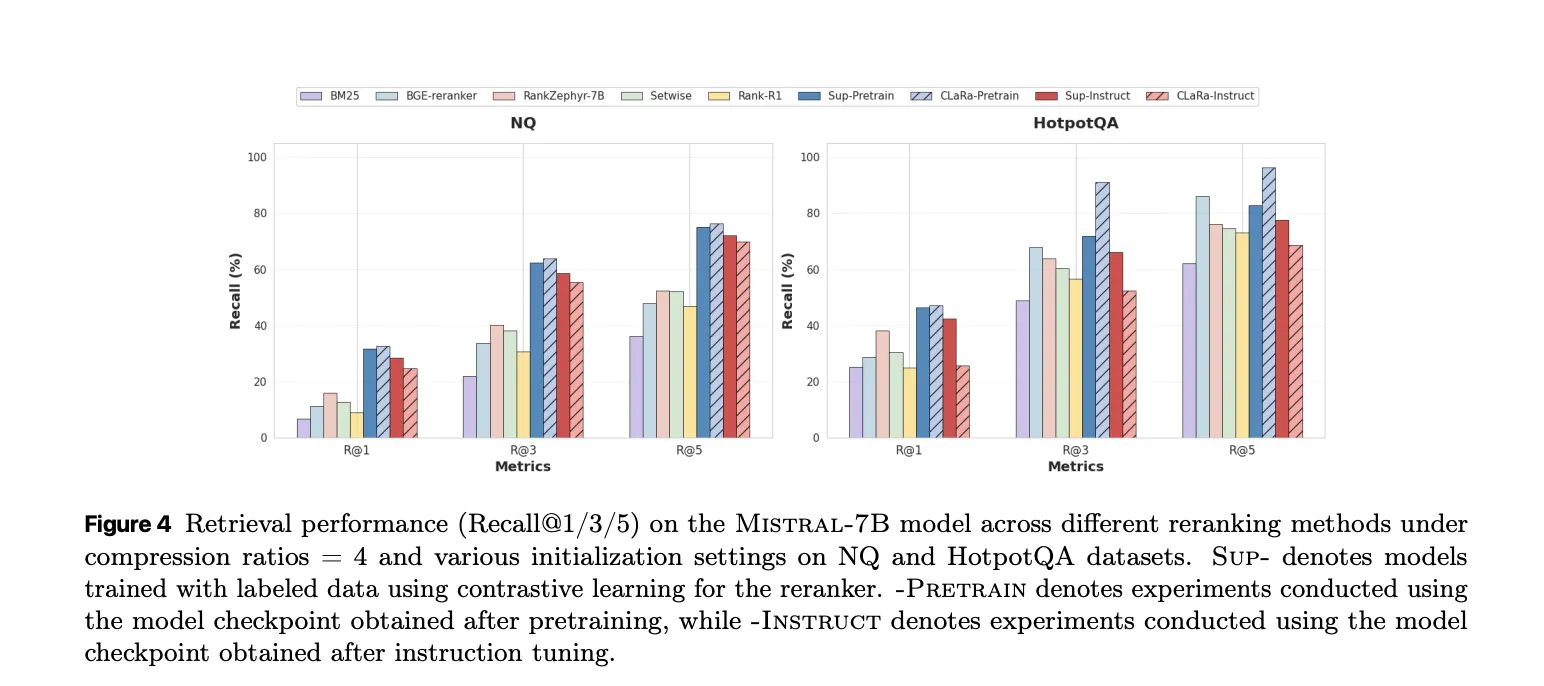
On the retrieval side, CLaRa used as a reranker under Oracle conditions delivers strong Recall at 5. With pretraining initialization at compression 4 on HotpotQA, CLaRa-Mistral-7B reaches Recall at 5 equal to 96.21. This beats the supervised BGE Reranker baseline at 85.93 by 10.28 points and even outperforms a fully supervised Sup Instruct retriever trained with contrastive relevance labels.

https://arxiv.org/pdf/2511.18659

What Apple has released?

Apple’s research team released 3 models on Hugging Face: CLaRa-7B-Base, CLaRa-7B-Instruct and CLaRa-7B-E2E. CLaRa-7B-Instruct is described as an instruction tuned unified RAG model with built in document compression at 16 and 128 times. It answers instruction style questions directly from compressed representations and uses Mistral-7B-Instruct v0.2 as the base model.

Key Takeaways

  1. CLaRa replaces raw documents with a small set of continuous memory tokens learned via QA guided and paraphrase guided semantic compression, which preserves key reasoning signals even at 16 times and 128 times compression.
  2. Retrieval and generation are trained in a single shared latent space, the query encoder and generator share the same compressed representations and are optimized together with one language modeling loss.
  3. A differentiable top-k estimator lets gradients flow from answer tokens back into the retriever, which aligns document relevance with answer quality and removes the usual disjoint tuning loop for RAG systems.
  4. On multi hop QA benchmarks like Natural Questions, HotpotQA, MuSiQue and 2WikiMultihopQA, CLaRa’s SCP compressor at 4 times compression outperforms strong text based baselines such as LLMLingua 2 and PISCO and can even beat full text BGE/ Mistral pipelines on average F1.
  5. Apple has released 3 practical models, CLaRa-7B-Base, CLaRa-7B-Instruct and CLaRa-7B-E2E, along with the full training pipeline on GitHub.

Editorial Notes

CLaRa is an important step for retrieval augmented generation because it treats semantic document compression and joint optimization in a shared continuous space as first class citizens, not afterthoughts bolted onto a text only pipeline. It shows that embedding based compression with SCP, combined with end to end training via a differentiable top-k estimator and a single language modeling loss, can match or surpass text based RAG baselines while using far shorter contexts and simpler retrieval stacks. Overall, CLaRa demonstrates that unified continuous latent reasoning is a credible alternative to classic chunk and retrieve RAG for real world QA workloads.


Check out the , and . Feel free to check out our . Also, feel free to follow us on  and don’t forget to join our  and Subscribe to . Wait! are you on telegram? 

The post appeared first on .

Read More

How to Design a Fully Local Multi-Agent Orchestration System Using TinyLlama for Intelligent Task Decomposition and Autonomous Collaboration


In this tutorial, we explore how we can orchestrate a team of specialized AI agents locally using an efficient manager-agent architecture powered by TinyLlama. We walk through how we build structured task decomposition, inter-agent collaboration, and autonomous reasoning loops without relying on any external APIs. By running everything directly through the transformers library, we create a fully offline, lightweight, and transparent multi-agent system that we can customize, inspect, and extend. Through the snippets, we observe how each component, from task structures to agent prompts to result synthesis, comes together to form a coherent human-AI workflow that we control end-to-end. Check out the .

!pip install transformers torch accelerate bitsandbytes -q


import torch
from transformers import AutoTokenizer, AutoModelForCausalLM, BitsAndBytesConfig
import json
import re
from typing import List, Dict, Any
from dataclasses import dataclass, asdict
from datetime import datetime


@dataclass
class Task:
   id: str
   description: str
   assigned_to: str = None
   status: str = "pending"
   result: Any = None
   dependencies: List[str] = None
  
   def __post_init__(self):
       if self.dependencies is None:
           self.dependencies = []


@dataclass
class Agent:
   name: str
   role: str
   expertise: str
   system_prompt: str

We set up all the core imports and define the fundamental data structures needed to manage tasks and agents. We define Task and Agent as structured entities to cleanly orchestrate work. By doing this, we ensure that every part of the system has a consistent and reliable foundation. Check out the .

AGENT_REGISTRY = {
   "researcher": Agent(
       name="researcher",
       role="Research Specialist",
       expertise="Information gathering, analysis, and synthesis",
       system_prompt="You are a research specialist. Provide thorough research on topics."
   ),
   "coder": Agent(
       name="coder",
       role="Software Engineer",
       expertise="Writing clean, efficient code with best practices",
       system_prompt="You are an expert programmer. Write clean, well-documented code."
   ),
   "writer": Agent(
       name="writer",
       role="Content Writer",
       expertise="Clear communication and documentation",
       system_prompt="You are a professional writer. Create clear, engaging content."
   ),
   "analyst": Agent(
       name="analyst",
       role="Data Analyst",
       expertise="Data interpretation and insights",
       system_prompt="You are a data analyst. Provide clear insights from data."
   )
}


class LocalLLM:
   def __init__(self, model_name: str = "TinyLlama/TinyLlama-1.1B-Chat-v1.0"):
       self.tokenizer = AutoTokenizer.from_pretrained(model_name)
       quantization_config = BitsAndBytesConfig(
           load_in_4bit=True,
           bnb_4bit_compute_dtype=torch.float16
       ) if torch.cuda.is_available() else None
       self.model = AutoModelForCausalLM.from_pretrained(
           model_name,
           quantization_config=quantization_config,
           device_map="auto",
           low_cpu_mem_usage=True
       )
       if self.tokenizer.pad_token is None:
           self.tokenizer.pad_token = self.tokenizer.eos_token
          
   def generate(self, prompt: str, max_tokens: int = 300) -> str:
       formatted_prompt = f"<|system|>nYou are a helpful AI assistant.</s>n<|user|>n{prompt}</s>n<|assistant|>n"
       inputs = self.tokenizer(
           formatted_prompt,
           return_tensors="pt",
           truncation=True,
           max_length=1024,
           padding=True
       )
       inputs = {k: v.to(self.model.device) for k, v in inputs.items()}
       with torch.no_grad():
           outputs = self.model.generate(
               **inputs,
               max_new_tokens=max_tokens,
               temperature=0.7,
               do_sample=True,
               top_p=0.9,
               pad_token_id=self.tokenizer.pad_token_id,
               eos_token_id=self.tokenizer.eos_token_id,
               use_cache=True
           )
       full_response = self.tokenizer.decode(outputs[0], skip_special_tokens=True)
       if "<|assistant|>" in full_response:
           return full_response.split("<|assistant|>")[-1].strip()
       return full_response[len(formatted_prompt):].strip()

We register all our specialized agents and implement the local LLM wrapper that powers the system. We load TinyLlama in an efficient 4-bit mode so we can run everything smoothly on Colab or local hardware. With this, we give ourselves a flexible and fully local way to generate responses for each agent. Check out the .

class ManagerAgent:
   def __init__(self, model_name: str = "TinyLlama/TinyLlama-1.1B-Chat-v1.0"):
       self.llm = LocalLLM(model_name)
       self.agents = AGENT_REGISTRY
       self.tasks: Dict[str, Task] = {}
       self.execution_log = []
      
   def log(self, message: str):
       timestamp = datetime.now().strftime("%H:%M:%S")
       log_entry = f"[{timestamp}] {message}"
       self.execution_log.append(log_entry)
       print(log_entry)
  
   def decompose_goal(self, goal: str) -> List[Task]:
       self.log(f"🎯 Decomposing goal: {goal}")
       agent_info = "n".join([f"- {name}: {agent.expertise}" for name, agent in self.agents.items()])
       prompt = f"""Break down this goal into 3 specific subtasks. Assign each to the best agent.


Goal: {goal}


Available agents:
{agent_info}


Respond ONLY with a JSON array."""
       response = self.llm.generate(prompt, max_tokens=250)
       try:
           json_match = re.search(r'[s*{.*?}s*]', response, re.DOTALL)
           if json_match:
               tasks_data = json.loads(json_match.group())
           else:
               raise ValueError("No JSON found")
       except:
           tasks_data = self._create_default_tasks(goal)
      
       tasks = []
       for i, task_data in enumerate(tasks_data[:3]):
           task = Task(
               id=task_data.get('id', f'task_{i+1}'),
               description=task_data.get('description', f'Work on: {goal}'),
               assigned_to=task_data.get('assigned_to', list(self.agents.keys())[i % len(self.agents)]),
               dependencies=task_data.get('dependencies', [] if i == 0 else [f'task_{i}'])
           )
           self.tasks[task.id] = task
           tasks.append(task)
           self.log(f"  ✓ {task.id}: {task.description[:50]}... → {task.assigned_to}")
      
       return tasks

We begin constructing the ManagerAgent class and focus on how we decompose a high-level goal into well-defined subtasks. We generate structured JSON-based tasks and automatically assign them to the right agent. By doing this, we allow the system to think step by step and organize work just like a human project manager. Check out the .

 def _create_default_tasks(self, goal: str) -> List[Dict]:
       if any(word in goal.lower() for word in ['code', 'program', 'implement', 'algorithm']):
           return [
               {"id": "task_1", "description": f"Research and explain the concept: {goal}", "assigned_to": "researcher", "dependencies": []},
               {"id": "task_2", "description": f"Write code implementation for: {goal}", "assigned_to": "coder", "dependencies": ["task_1"]},
               {"id": "task_3", "description": f"Create documentation and examples", "assigned_to": "writer", "dependencies": ["task_2"]}
           ]
       return [
           {"id": "task_1", "description": f"Research: {goal}", "assigned_to": "researcher", "dependencies": []},
           {"id": "task_2", "description": f"Analyze findings and structure content", "assigned_to": "analyst", "dependencies": ["task_1"]},
           {"id": "task_3", "description": f"Write comprehensive response", "assigned_to": "writer", "dependencies": ["task_2"]}
       ]
  
   def execute_task(self, task: Task, context: Dict[str, Any] = None) -> str:
       self.log(f"🤖 Executing {task.id} with {task.assigned_to}")
       task.status = "in_progress"
       agent = self.agents[task.assigned_to]
       context_str = ""
       if context and task.dependencies:
           context_str = "nnContext from previous tasks:n"
           for dep_id in task.dependencies:
               if dep_id in context:
                   context_str += f"- {context[dep_id][:150]}...n"
      
       prompt = f"""{agent.system_prompt}


Task: {task.description}{context_str}


Provide a clear, concise response:"""
       result = self.llm.generate(prompt, max_tokens=250)
       task.result = result
       task.status = "completed"
       self.log(f"  ✓ Completed {task.id}")
       return result

We define fallback task logic and the full execution flow for each task. We guide each agent with its own system prompt and provide contextual information to keep results coherent. This allows us to execute tasks intelligently while respecting dependency order. Check out the .

def synthesize_results(self, goal: str, results: Dict[str, str]) -> str:
       self.log("🔄 Synthesizing final results")
       results_text = "nn".join([f"Task {tid}:n{res[:200]}" for tid, res in results.items()])
       prompt = f"""Combine these task results into one final coherent answer.


Original Goal: {goal}


Task Results:
{results_text}


Final comprehensive answer:"""
       return self.llm.generate(prompt, max_tokens=350)
  
   def execute_goal(self, goal: str) -> Dict[str, Any]:
       self.log(f"n{'='*60}n🎬 Starting Manager Agentn{'='*60}")
       tasks = self.decompose_goal(goal)
       results = {}
       completed = set()
       max_iterations = len(tasks) * 2
       iteration = 0
      
       while len(completed) < len(tasks) and iteration < max_iterations:
           iteration += 1
           for task in tasks:
               if task.id in completed:
                   continue
               deps_met = all(dep in completed for dep in task.dependencies)
               if deps_met:
                   result = self.execute_task(task, results)
                   results[task.id] = result
                   completed.add(task.id)
      
       final_output = self.synthesize_results(goal, results)
       self.log(f"n{'='*60}n✅ Execution Complete!n{'='*60}n")
      
       return {
           "goal": goal,
           "tasks": [asdict(task) for task in tasks],
           "final_output": final_output,
           "execution_log": self.execution_log
       }

We synthesize the outputs from all subtasks and convert them into one unified final answer. We also implement an orchestration loop that ensures each task runs only after its dependencies are complete. This snippet shows how we bring everything together into a smooth multi-step reasoning pipeline. Check out the .

def demo_basic():
   manager = ManagerAgent()
   goal = "Explain binary search algorithm with a simple example"
   result = manager.execute_goal(goal)
   print("n" + "="*60)
   print("FINAL OUTPUT")
   print("="*60)
   print(result["final_output"])
   return result


def demo_coding():
   manager = ManagerAgent()
   goal = "Implement a function to find the maximum element in a list"
   result = manager.execute_goal(goal)
   print("n" + "="*60)
   print("FINAL OUTPUT")
   print("="*60)
   print(result["final_output"])
   return result


def demo_custom(custom_goal: str):
   manager = ManagerAgent()
   result = manager.execute_goal(custom_goal)
   print("n" + "="*60)
   print("FINAL OUTPUT")
   print("="*60)
   print(result["final_output"])
   return result


if __name__ == "__main__":
   print("🤖 Manager Agent Tutorial - APIless Local Version")
   print("="*60)
   print("Using TinyLlama (1.1B) - Fast & efficient!n")
   result = demo_basic()
   print("nn💡 Try more:")
   print("  - demo_coding()")
   print("  - demo_custom('your goal here')")
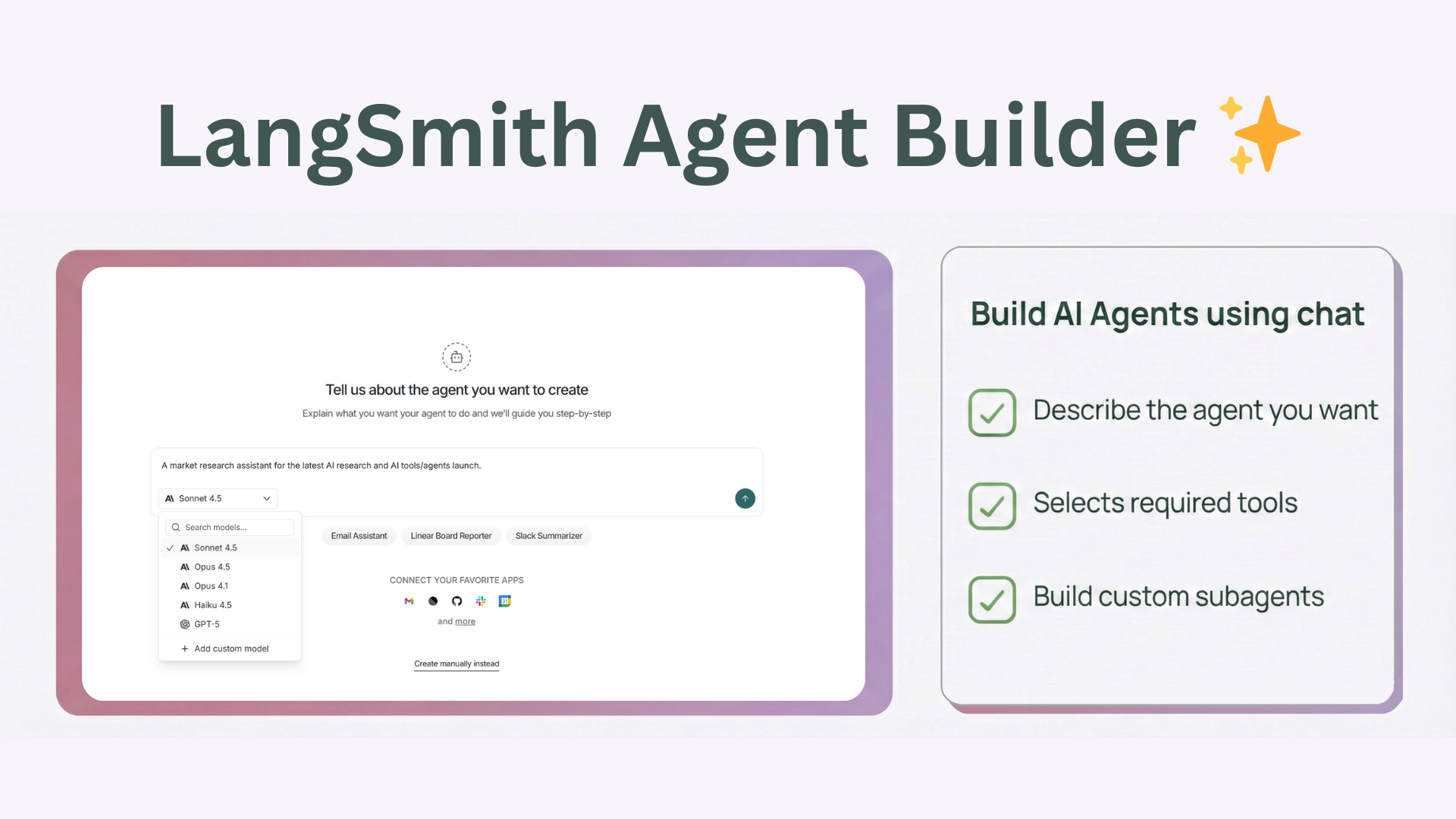

We provide demonstration functions to easily test our system with different goals. We run sample tasks to observe how the manager decomposes, executes, and synthesizes work in real time. This gives us an interactive way to understand the entire workflow and refine it further.

In conclusion, we demonstrate how to design and operate a complete multi-agent orchestration system locally with minimal dependencies. We now understand how the manager breaks down goals, routes tasks to the right expert agents, collects their outputs, resolves dependencies, and synthesizes the final result. This implementation allows us to appreciate how modular, predictable, and powerful local agentic patterns can be when built from scratch.


Check out the . Feel free to check out our . Also, feel free to follow us on  and don’t forget to join our  and Subscribe to . Wait! are you on telegram? 

The post appeared first on .

Read More